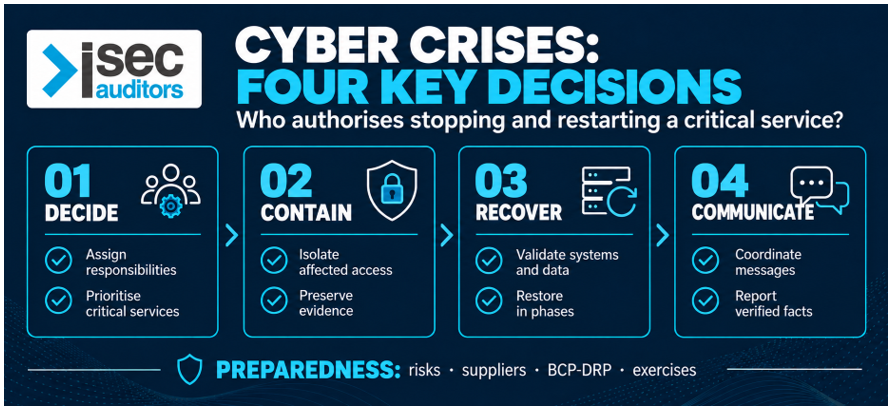
Madrid, 14 October 2026. Internet Security Auditors recommends bringing cybersecurity, incident response and business continuity into a coordinated preparedness programme. Defined responsibilities, priorities and recovery criteria help organisations act together when an attack requires services to be interrupted.
Forbes Argentina describes how Gracy Chen, Bitget’s CEO, managed the attack of 24 September. According to the company, approximately US$388 million in assets were affected, and the incident began with a vulnerability in a third-party security product. Bitget suspended withdrawals and restored them in phases after verification. [1, 2]
Preparedness to check. Identify critical processes and dependencies; review privileged access and suppliers; establish who authorises system isolation; preserve evidence; and practise recovery using validation criteria. Communications should be coordinated with the investigation and distinguish confirmed facts from hypotheses. Exercises help identify gaps before a crisis occurs. [3]
Internet Security Auditors services. Risk consulting, technical audits and penetration testing help prioritise improvements. Business continuity plans (BCP) and disaster recovery plans (DRP) should specify responsibilities, target recovery times and disruption scenarios. Reviewing and exercising these plans helps assess recovery capabilities and guide remediation. The resulting action plan should assign owners and priorities, with follow-up checks to verify improvements. [4, 5]
Referencias
[1] Forbes Argentina — Interview and Bitget crisis management (10 October 2026)[2] Bitget — Official incident information (accessed: 14 October 2026)
[3] NIST — SP 800-61r3: respuesta a incidentes y gestión del riesgo
[5] Internet Security Auditors — Penetration testing
[6] Internet Security Auditors — Security and continuity consulting
